
Blurry vision, trouble reading fine print, and glare from oncoming headlights can make daily life harder. Patients who start researching surgical options often see two procedures again and again: refractive lens exchange (RLE) and cataract surgery. Both remove the eye’s natural lens and replace it with an artificial one, but the reasons for choosing one over the other and the timing differ.
Table of Contents
What is Refractive Lens Exchange (RLE)?
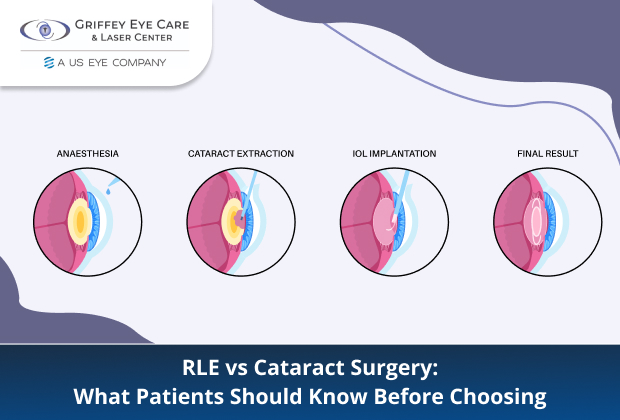
Refractive lens exchange, also called clear lens exchange (CLE) or lens replacement surgery, is an elective procedure that corrects refractive errors by replacing a clear natural lens with an artificial intraocular lens (IOL). It is often recommended for patients over age 40 who are living with presbyopia, significant farsightedness, or other vision issues that make them poor candidates for corneal procedures such as LASIK. During RLE, the surgeon creates a small incision, removes the natural lens with ultrasound or laser energy, and places an IOL chosen for the patient’s prescription and goals. Because the natural lens is removed, a cataract cannot form in that eye later in life.
What is Cataract Surgery?
Cataract surgery is a medically necessary procedure used to treat cataracts, which occur when the eye’s natural lens becomes cloudy and interferes with vision. Cataracts are a common part of aging and can cause vision to become dim, blurred, or yellowed over time. When cataracts make it difficult to drive safely, read, or perform routine activities, surgery is the only effective way to restore clarity. Cataract surgery uses the same basic technique as RLE: the surgeon removes the cloudy lens through a small incision and replaces it with a clear IOL.
RLE vs Cataract Surgery: Key Differences
The surgical techniques for RLE and cataract surgery are closely related, but their intent and coverage differ. RLE is an elective vision correction procedure for patients who want to reduce dependence on glasses or contacts and who do not yet have a visually significant cataract. Cataract surgery is performed when a cloudy lens is already reducing vision and quality of life and is considered medically necessary. It is usually covered by insurance or Medicare when specific criteria are met, although patients may choose to pay extra for premium IOLs that address astigmatism or presbyopia. RLE, like LASIK, is typically not covered by insurance.
Understanding Intraocular Lenses (IOLs)
Both RLE and cataract surgery rely on intraocular lenses to focus light after the natural lens is removed. Monofocal lenses provide clear vision at a single distance, most often far, and many patients still use reading glasses. Multifocal and extended depth-of-focus (EDOF) lenses allow more than one range of vision to be useful, which may reduce the need for glasses at near and intermediate distances. Some lenses also incorporate astigmatism correction. A Griffey Eye Care surgeon reviews these choices and recommends IOL types that match the measurements and health of each eye.
Disadvantages of Lens Replacement Surgery and RLE Eye Surgery Side Effects
RLE and cataract surgery are well-established and generally safe, but lens replacement surgery is not free of disadvantages or risk. Because RLE is elective, it is especially important to understand the potential side effects of RLE eye surgery before deciding to proceed.
Common issues after RLE or cataract surgery can include visual disturbances such as glare, halos, or starbursts around lights, particularly at night. These symptoms often lessen as the brain adapts, but can persist in some cases, especially with certain multifocal or EDOF lenses.
Temporary dryness, foreign-body sensation, or fluctuating vision may occur as the eye’s surface heals, and pre-existing dry eye may be unmasked or worsened. Months or years after surgery, the membrane that holds the IOL can become cloudy, a change called posterior capsular opacification (PCO). This is sometimes called a “secondary cataract” and is usually treated with a brief laser procedure called a YAG capsulotomy.
For patients who continue to experience vision problems after surgery or who are concerned about their long-term results, it’s natural to wonder whether a lens procedure can be repeated. Learn more about whether cataract surgery can be safely redone.
More serious risks are rare but include infection inside the eye, bleeding, and retinal detachment. The risk of retinal detachment is higher for patients with significant nearsightedness, which is more common in candidates for refractive lens exchange. A thorough examination helps the surgeon determine whether RLE is appropriate and how to reduce these risks as much as possible.
Frequently Asked Questions
Can RLE be reversed if I am unhappy with the result?
The IOL placed during RLE is intended to remain in the eye for life. In select situations, a lens exchange or additional procedure may be considered, but this carries added risk, which is why detailed planning before surgery is so important.
How long is the recovery after RLE or cataract surgery?
Many patients notice clearer vision within days, although vision can fluctuate as the eye heals. A return to light daily activities is often possible soon after surgery, while full stabilization can take several weeks.
Are both eyes treated on the same day?
Lens replacement surgery is usually performed on one eye at a time. The second eye is commonly treated at a separate visit after the first eye has healed and vision has been evaluated.
Making the Right Choice for Your Eyes
Choosing between refractive lens exchange and cataract surgery depends on how clear the lens is and how much symptoms interfere with everyday tasks. Someone in midlife with clear lenses and strong prescriptions may talk with a surgeon about RLE to reduce reliance on glasses. When a cataract is already clouding vision or making night driving difficult, cataract surgery usually becomes the next step. A complete exam at Griffey Eye Care helps sort out these options. The doctor reviews test results, discusses goals, and recommends either surgery now or continued monitoring based on what is safest for the eyes. Request your appointment now.